
What is CD-CODE?
CD-CODE 2.0: An enhanced condensate knowledgebase integrating pathobiology, modulators, and host–pathogen interactions
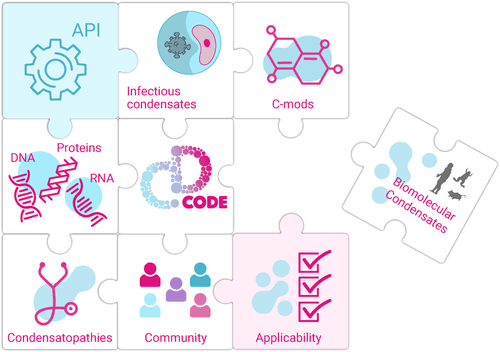
CD-CODE (CrowDsourcing COndensate Database and Encyclopedia) is a continuously updated versatile semi-manually curated crowdsourcing database of biomolecular condensates and their constituents (proteins and nucleic acids), including a repository of infectious condensates , condensate modulating drugs ( c-mods ) and condensate aberrations across diverse disease contexts ( condensatopathies ), as well as an encyclopedia for the scientific terms used to describe them. Biomolecular condensates are micron-scale compartments that selectively concentrate biomolecules, mainly proteins and nucleic acids but lack surrounding lipid membranes.
CD-CODE is a semi-manually curated and annotated database that aggregates information from primary literature and other protein and LLPS databases.
- Uniprot: https://uniprot.org
- PubChem: https://pubchem.ncbi.nlm.nih.gov
- ChEMBL: https://www.ebi.ac.uk/chembl/
- Disease Ontology Knowledgebase: https://disease-ontology.org
- Ensemble: https://www.ensembl.org/index.html
- PubMed: https://pubmed.ncbi.nlm.nih.gov
- PhaSePro: https://phasepro.elte.hu
- LLPSDB: http://bio-comp.org.cn/llpsdb/home.html
- DrLLPS: http://llps.biocuckoo.cn
- PhaSepDB: http://db.phasep.pro
We extract information from the literature of which proteins are members of biomolecular condensates and provide experimental evidence for each condensate-protein relationship. We rely on condensates.com literature curation engine to continously assemble all relevant papers published.
The standardisation of terms and condensate nomenclature supports our understanding of condensate proteomes across organisms.
CD-CODE is a "living database" that was designed for dynamic and fast addition and review of information about condensates and proteins by contributing users and is open to expert researcher who wishes to contribute. Our user management system supports three types of users: viewers, contributors and maintainers. Viewers can read and download the curated information. Contributors can suggest edits to the existing information and propose new condensate and protein entries. Maintainers can curate the changes and accept or reject suggestions by contributors, who are then notified about the status and can engage in further discussion.
If you are interested in becoming a contributor, please join us here.
Subscribe to our newsletter here.
How to cite us?
If you use CD-CODE in a scientific publication, we would appreciate citation to the following paper:
2025
"CD-CODE 2.0: an enhanced condensate knowledgebase integrating pathobiology, condensate modulating drugs, and host–pathogen interactions"
Ksenia Kuznetsova, Maxim Scheremetjew, Jialin Yin, HongKee Moon, Diego A Vargas, Anna Hadarovich, Natasha Lewis, Carsten Hoege, Chi Fung Willis Chow, David Kuster, Jik Nijssen, Alberto Hernandez-Armendariz, Jonathan C Savage, Yu Wei, Silja Zedlitz, Hari Raj Singh, Soumyadeep Ghosh, Allysa P Kemraj, Lena Hersemann, Anthony A Hyman, Diana M Mitrea, Agnes Toth-Petroczy, Nucleic Acids Research (2025).
https://academic.oup.com/nar/advance-article/doi/10.1093/nar/gkaf1104/8317324
DOI: 10.1093/nar/gkaf1104
📋 BibTeX Citation (click to expand)
@ARTICLE{Kuznetsova2025-xc,
  title     = "{CD-CODE} 2.0: an enhanced condensate knowledgebase integrating
               pathobiology, condensate modulating drugs, and host-pathogen
               interactions",
  author    = "Kuznetsova, Ksenia and Scheremetjew, Maxim and Yin, Jialin and
               Moon, Hongkee and Vargas, Diego A and Hadarovich, Anna and
               Lewis, Natasha and Hoege, Carsten and Chow, Chi Fung Willis and
               Kuster, David and Nijssen, Jik and Hernandez-Armendariz, Alberto
               and Savage, Jonathan C and Wei, Yu and Zedlitz, Silja and Singh,
               Hari Raj and Ghosh, Soumyadeep and Kemraj, Allysa P and
               Hersemann, Lena and Hyman, Anthony A and Mitrea, Diana M and
               Toth-Petroczy, Agnes",
  abstract  = "CD-CODE 2.0 (https://cd-code.org) is an enhanced web application
               and database of condensates, expanding the utility of version
               1.0 for biomedical research. New features include data on
               nucleic acids condensate components, infectious condensates,
               condensate modulating drugs, and disease-linked condensates.
               Enhanced search functions, programmatic access, and relational
               architecture enable interconnectivity across major biomedical
               databases (e.g. condensates, proteins, chemistry, and disease),
               fostering systems-level insights and accelerating hypothesis
               generation and therapeutic discovery through the lens of
               condensate biology.",
  journal   = "Nucleic Acids Res.",
  publisher = "Oxford University Press (OUP)",
  number    = "gkaf1104",
  month     =  nov,
  year      =  2025,
  copyright = "https://creativecommons.org/licenses/by-nc/4.0/",
  language  = "en"
  doi       = "10.1093/nar/gkaf1104",
  url       = "https://doi.org/10.1093/nar/gkaf1104"
}
2023
"CD-CODE: crowdsourcing condensate database and encyclopedia"
Nadia Rostam, Soumyadeep Ghosh, Chi Fung Willis Chow, Anna Hadarovich, Cedric Landerer, Rajat Ghosh, HongKee Moon, Lena Hersemann, Diana M. Mitrea, Isaac A. Klein, Anthony A. Hyman, Agnes Toth-Petroczy, Nat Methods (2023).
https://www.nature.com/articles/s41592-023-01831-0
DOI: 10.1038/s41592-023-01831-0
📋 BibTeX Citation (click to expand)
@ARTICLE{Rostam2023-zf,
  title    = "{CD-CODE}: crowdsourcing condensate database and encyclopedia",
  author   = "Rostam, Nadia and Ghosh, Soumyadeep and Chow, Chi Fung Willis and
              Hadarovich, Anna and Landerer, Cedric and Ghosh, Rajat and Moon,
              Hongkee and Hersemann, Lena and Mitrea, Diana M and Klein, Isaac
              A and Hyman, Anthony A and Toth-Petroczy, Agnes",
  abstract = "The discovery of biomolecular condensates transformed our
              understanding of intracellular compartmentalization of molecules.
              To integrate interdisciplinary scientific knowledge about the
              function and composition of biomolecular condensates, we
              developed the crowdsourcing condensate database and encyclopedia
              ( cd-code.org ). CD-CODE is a community-editable platform, which
              includes a database of biomolecular condensates based on the
              literature, an encyclopedia of relevant scientific terms and a
              crowdsourcing web application. Our platform will accelerate the
              discovery and validation of biomolecular condensates, and
              facilitate efforts to understand their role in disease and as
              therapeutic targets.",
  journal  = "Nat. Methods",
  volume   =  20,
  number   =  5,
  pages    = "673--676",
  month    =  may,
  year     =  2023,
  language = "en",
  issn     = "1548-7105",
  doi      = "10.1038/s41592-023-01831-0",
  url      = "https://doi.org/10.1038/s41592-023-01831-0"
}
Newsletter
Subscribe to our newsletter to stay up to date with the latest CD-CODE news and updates.
Definitions at CD-CODE
Biomolecular condensates: Membrane-less organelles that selectively concentrate biomolecules, mainly proteins and nucleic acids in vivo.
Infectious condensates: Biomolecular condensates that are formed upon infection of the host organism by pathogen (virus or bacteria) with their annotated host and pathogen protein and nucleic acids components. Biomolecular and infectious condensates are annotated according to their protein constituents and information on containing nucleic acids, RNA and DNA.
Synthetic condensates: In vitro experiments that demonstrate condensate formation, usually via liquid-liquid phase separation.
Markers: Proteins that are used to define and label/mark a specific biomolecular condensate. Markers are often drivers.
Proteins in CD-CODE are divided into two groups:
1. Drivers: Proteins which fulfill at least one of the following criteria.
- Induce the formation of a condensate.
- Are essential for the integrity of a condensate.
2. Members: Proteins which are part of a condensate but their role is unknown.
It is important to note that a particular protein may be a driver in one condensate and a member in another one.
C-mods: Condensate modifying compound, also referred to as condensate modulator or condensate modulating drug, is a molecule that modifies the properties of a biomolecular condensate (PMID: 35974095).
C-mods in CD-CODE are divided into 4 groups based on their mode of action (MOA) (PMID: 35974095):
- Inducer: A compound or biomolecule that promotes formation of a condensate.
- Dissolver: A compound or biomolecule that promotes dissolution of a condensate.
- Localizer: A compound or biomolecule that promotes relocalization of a biomolecule from or to a condensate.
- Morpher: A compound or biomolecule that promotes changes in the morphology of a biomolecular condensate.
Condensatopathy: An aberrant condensate phenotype associated with disease pathophysiology, supported by experimental evidence in relevant cellular, animal and/or clinical models. A condensatopathy can be viewed as a biomarker – it could be a driver or an effect of the disease, but in either case it is strongly associated with, and reports on the diseased state (PMID: 35974095).
Nucleic Acid information: We annotate nucleic acid (RNA and DNA) components within condensates based on experimental evidence and note if they are shown to associate with specific proteins-members of the condensate. For additional RNA classifications in condensates, we recommend consulting the RPS database https://rps.renlab.cn (PMID: 39460625).
Confidence score for a protein belonging to a condensate (max. 5 stars):
| Number of stars | Description |
|---|---|
| PubMed reference annotated | |
| High throughput experiment (eg. mass spectrometry) | |
| In vitro | |
| In cellulo | |
| In vivo |
Confidence score for a condensate (max. 5 stars): median of the confidence scores of its member proteins.
CD-CODE information flow
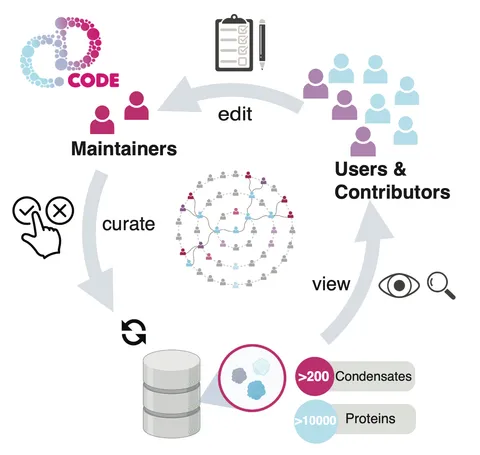
CD-CODE information flow. Users can view and search the data, or become a contributor after registration, and edit the content of the database. The maintainers assure quality control and only approved edits will be part of the dynamically updated database. Moreover, maintainers keep the database up to date by manually curating newly released research.
Currently, CD-CODE contains curated data about more than 700 condensates and more than 10000 proteins which can be viewed by users.
Join us and become a contributor or maintainer.
Limitations of CD-CODE
The main limitation of CD-CODE is that it contains only experimentally validated entries and therefore it is heavily biased towards researcher’s choices to study condensates and in select organisms. We deliberately have not included any predictions, since inferring if condensate exists in other organisms and if an orthologous protein would be part of a condensate in an orthologous condensate is a non-trivial question. Any missing information could mean that the protein or condensate 1) has not been studied yet; 2) there is a research paper but the information has not been added to the database yet; 3) the condensate truly does not exist or the protein truly does not belong to a given condensate. The database is continuously undergoing curation and users can refer to scores and experimental evidence to guide their decision-making.
License
CD-CODE is licensed under a Creative Commons Attribution-NonCommercial 4.0 International License.
